
8 min read
Two AI Trends We're Betting On
Dear
The first wave of AI won attention. Chatbots, copilots, and assistants have proven that AI can improve productivity. They became useful, widely adopted, and increasingly commoditized.
The next wave is competing for something far more valuable than attention: the right to become part of an organization’s operating budget.
The companies that win won’t necessarily have the smartest models. They’ll be the ones that become indispensable to how organizations operate. Whether that’s knowledge work, warehouse operations, or hospital workflows, the common thread is the same: AI that automates high-value workflows, increases employee productivity, and delivers measurable business outcomes.
Today, most AI still operates at the assistance layer—better search, faster drafts, smarter suggestions. We believe the larger opportunity lies in AI that owns mission-critical workflows rather than simply helping people complete individual tasks.
That’s the lens behind our last four investments.
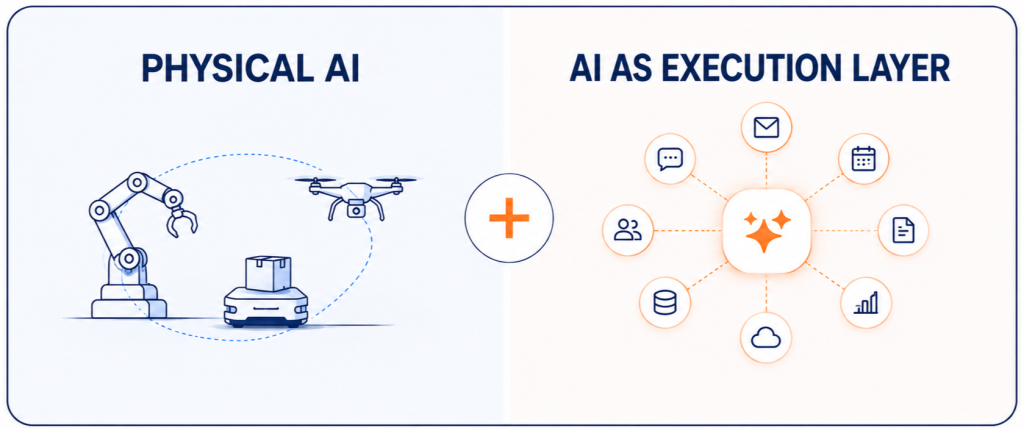
Over the past 12 months, we invested in four companies Blue, Slashy, Unit AI, and Shyld, that reflect two themes we believe will define the next phase of AI adoption: AI in the Physical World and AI as an Execution Layer.
AI in the Physical World
The first wave of AI transformed knowledge work. We believe the next wave will transform the physical world.
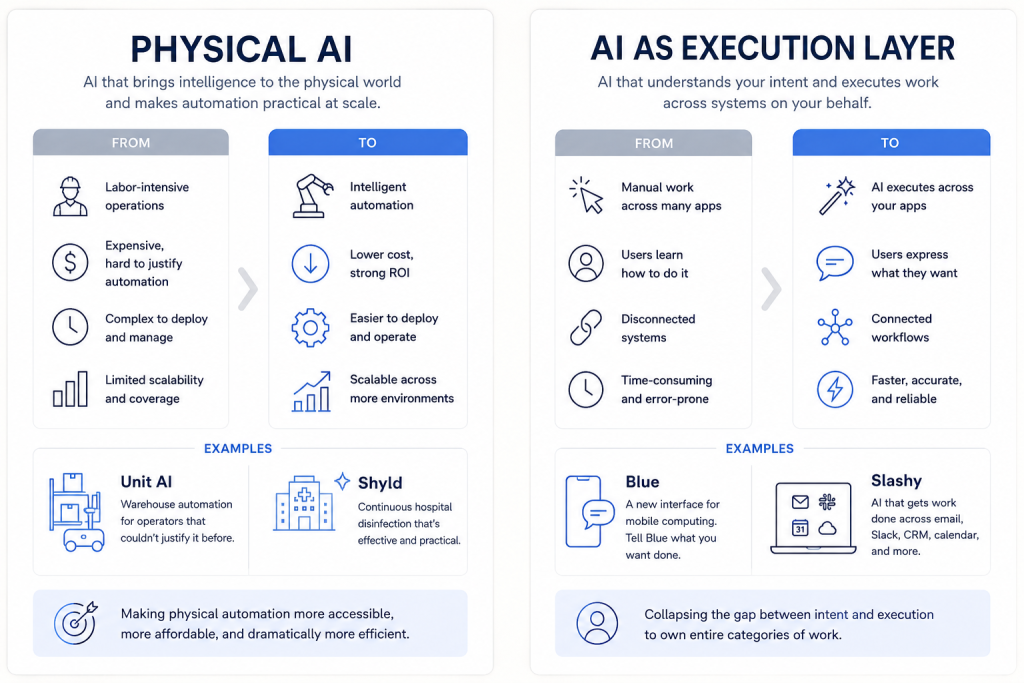
Many industries already know how to solve their biggest operational challenges. The limitation isn’t a lack of solutions—it’s that physical automation has historically been too expensive, too labor-intensive, or too operationally complex to deploy at scale. AI is changing that equation, making physical automation economically viable where it previously wasn’t.
Two of our recent investments illustrate this shift in very different industries.
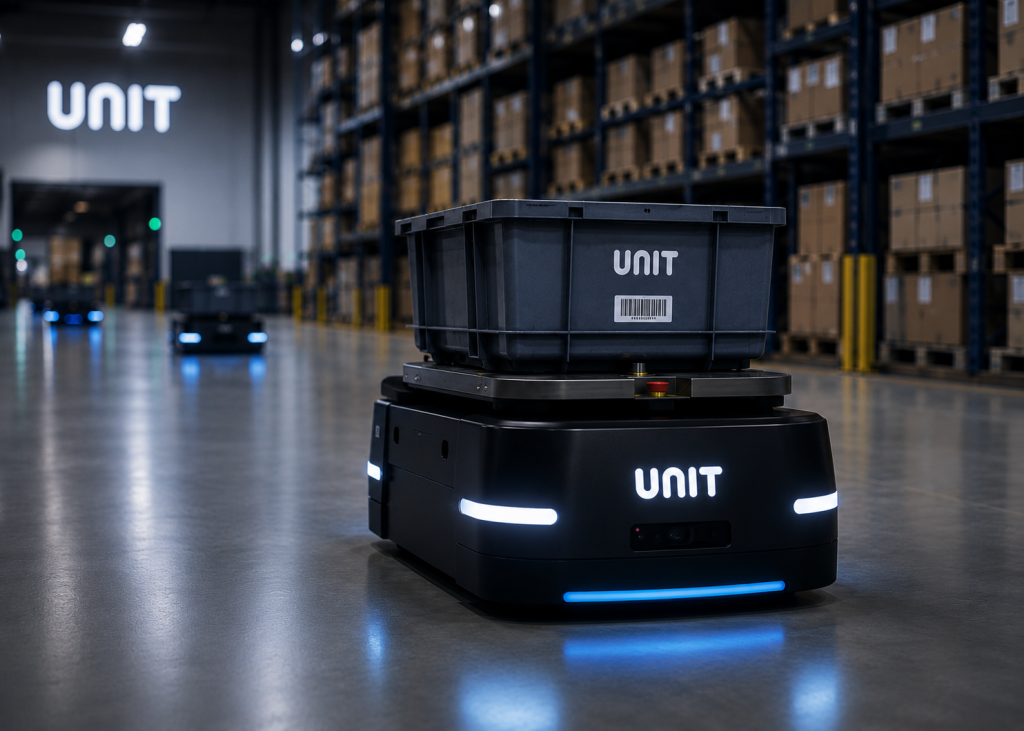
Unit AI is bringing warehouse automation to operators that historically could not justify traditional automation systems.
Shyld is making continuous hospital disinfection economically viable without the labor burden and workflow disruption that limited prior approaches.
Neither company is simply improving an existing process. They are fundamentally changing the economics of automation, making solutions practical where they previously weren’t.
We believe many of the biggest AI companies won’t create entirely new markets. Instead, they’ll unlock existing ones by making physical automation more accessible, more affordable, and dramatically more efficient.
AI as an Execution Layer
Historically, software has helped people work more efficiently by giving them better tools. AI is enabling something fundamentally different: software that can execute on a user’s behalf.
The shift isn’t simply the rise of AI agents. It’s a new interaction model. Instead of navigating interfaces and workflows, people express intent, and software determines how to accomplish it.
Two of our recent investments illustrate this shift.
Blue is building a new interface for mobile computing. Instead of navigating apps, users simply tell Blue what they want done, and it executes across their phone.
Slashy applies the same idea to knowledge work, coordinating tasks across email, Slack, CRMs, calendars, and other business systems on the user’s behalf.
In both cases, AI is collapsing the gap between intent and execution.
We believe the best AI software companies won’t merely help users perform tasks more efficiently. They’ll become the execution layer for entire workflows, taking responsibility for work that previously required human coordination.

Our View
Much of today’s AI conversation focuses on models and capabilities. We believe the more important question is an economic one: can AI deliver enough ROI to earn budget authority?
Companies don’t create budgets for interesting technology. They create budgets for products that automate critical workflows, reduce costs, mitigate risk, or materially improve business and economic performance.
AI has already proven it can generate content. The next question is whether it can become indispensable to how organizations operate.
That’s why we believe the next generation of category-defining AI companies won’t be defined by the intelligence of their models.
They’ll be defined by the economic value they create. The winners won’t be measured by the number of tokens they generate. They’ll be measured by the productivity they unlock, the costs they reduce, and the outcomes they deliver.
Stay Connected
Receive our occasional thought pieces and insights.
Copyright © 2025 Think Plus+ Venture